Your Health Dashboard: A Simple Early Warning System for Your Body
Most people know their car has a dashboard.
If the fuel is low, the light comes on. If the engine overheats, the warning appears. If the tyre pressure drops, the system tells you before the problem becomes dangerous.
Your body has a dashboard too. The readings are just harder to notice.
A little more breathlessness. Slight swelling around the ankles. A few missed tablets. Poor sleep. A resting heart rate that is creeping upwards. A gradual drop in exercise tolerance.
Individually, these may not seem dramatic. But together, they can tell an important story.
That is why I created the Health Dashboard.
It is a practical record designed to help you notice changes early, bring better information to your care team, and make sense of what your body is doing.
The signals that arrive before the crisis
In cardiology, we often see patients after a problem has already become obvious. Sometimes that is unavoidable. Symptoms can come suddenly and without warning.
But quite often, the body has been sending smaller signals for days or weeks before the crisis arrives. The problem is not that you do not care. The problem is that these changes can be subtle, gradual, and easy to normalise.
You may think: "I'm just getting older." "I'm probably tired." "I'll see how it goes." "It's not bad enough to bother anyone."
Sometimes that is reasonable. But sometimes the pattern matters.
The Health Dashboard is not about becoming anxious or constantly monitoring yourself. It is about developing a calm, practical habit of noticing.
Noticing gives you choices.
The eight daily or weekly checks
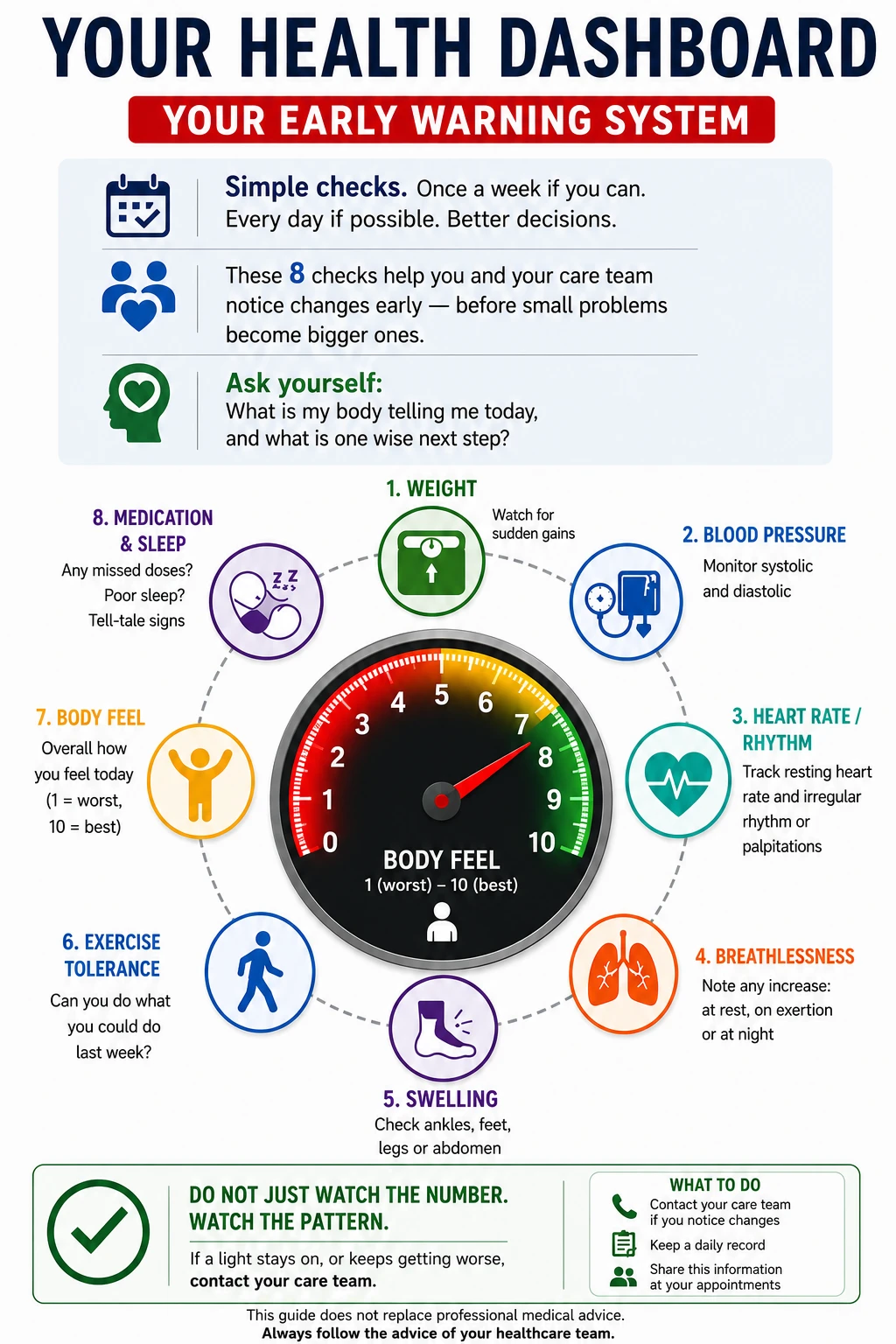
The dashboard is built around eight simple checks. You do not need to do all of them perfectly every day. For many people, once a week is a good start. If you are living with heart failure, high blood pressure, atrial fibrillation, coronary artery disease, valve disease, or other long-term cardiovascular conditions, more regular monitoring may be useful.
1. Weight
A sudden increase in weight can sometimes suggest fluid retention, especially in people with heart failure. One isolated number rarely tells you much. What matters is whether your weight is rising quickly over a few days.
2. Blood pressure
Blood pressure varies naturally during the day. One high reading does not always mean something serious. But repeated high readings, very low readings, or a clear change from your usual pattern may be important.
3. Heart rate and rhythm
A resting heart rate that is persistently higher than usual, or an irregular rhythm with palpitations, dizziness, breathlessness, or chest discomfort, should not be ignored.
4. Breathlessness
Ask yourself whether your breathing has changed. Are you more breathless walking on the flat? Climbing stairs? Lying down? Waking at night short of breath? A change in breathlessness is often one of the most important warning signs.
5. Swelling
Check ankles, feet, legs, and sometimes the abdomen. New or worsening swelling can be a sign of fluid retention or circulation problems.
6. Exercise tolerance
This is one of the most practical health measures. Can you do what you could do last week? Can you walk the same distance? Climb the same stairs? Carry the same shopping? A change in function often matters more than a single number.
7. Body feel
This is your overall sense of how you are. "Your engine warning light." On the dashboard, this is scored from 1 to 10. It is deliberately simple. You are not diagnosing yourself. You are asking: "How does my body feel today compared with normal?"
8. Medication and sleep
Missed medication, poor sleep, dehydration, alcohol, stress, and intercurrent illness can all affect the cardiovascular system. These are often the hidden variables behind changes in blood pressure, heart rhythm, energy, and symptoms.
Why the pattern matters more than the number
One blood pressure reading, one bad night, or one day of feeling below par may not mean very much. But a pattern does.
The most important message of the dashboard is this: do not just watch the number. Watch the pattern.
A weight increase of 2–3 kg over a few days may matter more than a single isolated weight. A resting heart rate that is gradually increasing may matter more than one slightly high reading. Breathlessness that is slowly worsening may matter more than one difficult day. Repeated missed medication may explain why blood pressure or symptoms are becoming unstable.
Patterns help you and clinicians make better decisions. They turn vague impressions into useful information.
Instead of saying, "I haven't felt right," you may be able to say: "My weight has gone up by 2 kg this week, my ankles are more swollen, and I am more breathless walking upstairs."
Clinicians can act on that. It helps your GP, nurse, pharmacist, or cardiologist understand what is changing and how quickly.
The body-feel gauge: your engine warning light
At the centre of the dashboard is a simple gauge from 1 to 10. This is not a scientific diagnostic score. It is a practical reflection tool.
The colour zones work like an engine warning system:
0–5: Red zone
Something may be changing. If this is new, persistent, or worsening, it may be time to contact your care team. The red zone does not mean failure. It means your body may be asking for attention.
5–6: Amber zone
The caution zone. Watch closely. Ask what has changed. Have you missed medication? Slept badly? Become dehydrated? Developed an infection? Are symptoms beginning to shift?
6–10: Green zone
Relative stability. Keep monitoring, continue your usual routines, and stay aware of changes.
That distinction matters. This dashboard is not about blame. It is about awareness, self-respect, and earlier action.
The question behind the number
Numbers are useful. They are not enough.
Good care also needs reflection. That is why the dashboard includes one simple question:
What is my body telling me today, and what is one wise next step?
This question is deliberately gentle. It does not ask, "Have I been good?" It does not create guilt. It does not assume perfect habits. It invites attention.
Sometimes the wise next step is to take your medication as prescribed. Sometimes it is to rest. Sometimes it is to go for a short walk. Sometimes it is to check your blood pressure again later. Sometimes it is to contact your GP, heart failure nurse, pharmacist, or cardiology team.
The aim is not to create anxiety. The aim is to create a small pause between noticing and acting.
When to contact your care team
The dashboard is not a replacement for medical advice. It is a way of helping you notice when advice may be needed.
Contact your care team if a warning sign persists, keeps worsening, or appears alongside other changes. Examples include:
- Worsening breathlessness
- New or increasing ankle swelling
- Sudden weight gain over a few days
- Chest pain or tightness
- Palpitations with dizziness, faintness, or collapse
- Persistently very high or very low blood pressure
- A resting heart rate that is unusually fast or irregular for you
- A marked drop in exercise tolerance
- Repeated missed medication, or side effects that stop you taking treatment
For severe chest pain, severe breathlessness, collapse, symptoms of stroke, or any situation that feels like an emergency: seek urgent medical help immediately.
A practical habit, not a perfect system
The Health Dashboard is intentionally simple. It does not require a complicated app. It does not require medical training. It does not ask you to become obsessed with data.
It asks you to notice eight things, gently and regularly.
Once a week if you can. Every day if possible. The habit matters more than the frequency.
For some patients, the dashboard may be most useful after a new diagnosis. For others, it may help after a hospital admission, a medication change, a new symptom, or a period of uncertainty.
It can also be useful before appointments. Bringing a short record of your symptoms, blood pressure, heart rate, weight, and exercise tolerance can make consultations more focused and more productive.
The real purpose: earlier conversations
The purpose of the Health Dashboard is not to turn patients into clinicians. It is to support better conversations.
When patients notice patterns earlier, clinicians can respond earlier. When information is clearer, decisions are safer. When patients understand their own warning signs, care becomes more collaborative.
Healthcare works best when it is not only reactive.
A dashboard helps us move from crisis response to early recognition. From vague worry to useful observation. From isolated numbers to meaningful patterns. From "I'll see how it goes" to "I know what has changed, and I know what to do next."
Your body is speaking all the time. The Health Dashboard is how you listen back.